If you’ve been researching managed IT and landed on pages full of acronyms and vendor language, this is the plain-English version.
The term “managed IT services“ gets used by everyone from sole-operator consultants to enterprise firms, which makes it harder than it should be to understand what you’re actually buying, what it costs, and whether your business is the right size for it.
This guide answers all three.
The 30-Second Definition
Managed IT services means outsourcing the ongoing management of your technology to a third-party company on a fixed monthly contract.
Instead of calling someone when something breaks, you have a team that’s already watching your systems, already patching your software, and already responding to threats before you know they exist.
You pay a predictable monthly fee. They handle the IT. You run your business.
What Is Actually Included
Managed IT services packages vary, but a full-service contract typically covers:
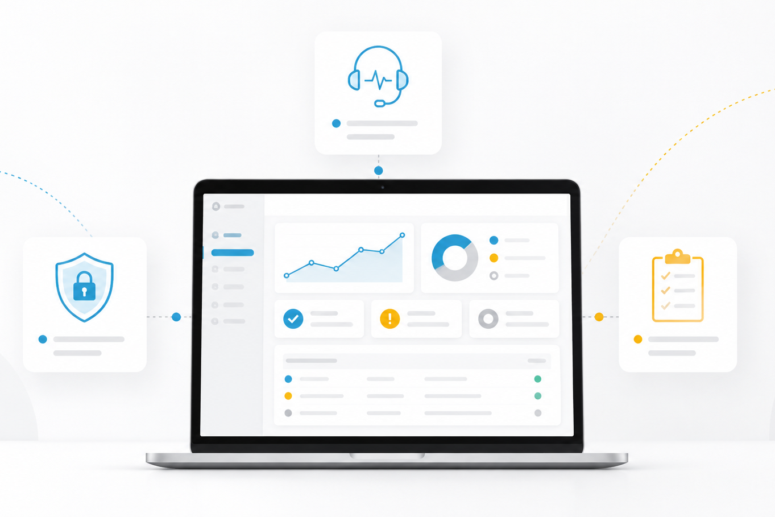
- Remote monitoring and management (RMM) — servers, workstations, and network devices watched around the clock
- Helpdesk and technical support — a number to call, a portal to submit tickets, answered by someone who knows your system
- Patch management — software updates and security patches deployed automatically and tested before rollout
- Cybersecurity tools — endpoint detection, email filtering, multi-factor authentication, threat response
- Backup and disaster recovery — daily automated backups, tested regularly, with a documented recovery process
- vCIO / strategic IT planning — quarterly reviews of your technology roadmap, budget, and upcoming infrastructure needs
Some providers charge per device. Others charge per user, generally simpler and easier to budget as your team grows.
Why Toronto Businesses Switch to Outsourced IT Management
Three triggers come up consistently when businesses explain what prompted the move to outsourced IT management:
A security incident. A phishing attack, a ransomware infection, or a credential breach. After it happens, the business realizes their reactive setup had no real defense and no documented recovery plan.
A growth threshold. At around 10–15 staff, managing IT informally becomes unsustainable. Too many devices, too much surface area for problems, not enough time.
A painful downtime event. A server failure that took 18 hours to resolve because no one had documentation of how the environment was configured.
All three are predictable. Managed IT services prevent them.
The Canadian Compliance Angle
Canada’s privacy laws put real obligations on any business that collects personal data, which includes customer names, email addresses, payment information, and health records.
PIPEDA requires businesses to implement “appropriate safeguards” proportional to the sensitivity of the information they hold. A managed IT partner provides the documented security controls, incident response procedures, and data handling policies that satisfy those requirements.
For Toronto businesses in healthcare, legal, financial services, or the nonprofit sector, this isn’t optional. It’s due diligence.
What Managed IT Services Cost in Toronto
Managed IT services pricing across Toronto providers typically runs $100–$250 CAD per user per month for a full-service contract, with the range reflecting scope more than location.
What that range actually buys:
- Lower end ($100–$150): business-hours help desk, basic monitoring, standard patching
- Higher end ($180–$250): 24/7 support, full security stack, compliance reporting, vCIO planning
Variables that affect your number:
- Number of users and devices
- 24/7 vs. business-hours support
- Security stack complexity
- Whether servers are on-premises or fully cloud-hosted
- Contract length
For a 20-person team at $150/user: $3,000/month, or $36,000/year. Compare that to a single IT hire in Canada, which runs roughly $75,000–$100,000/year once salary, benefits, training, and turnover risk are factored in, for one person covering one area of expertise.
Compare it too to the cost of recovering from a serious ransomware incident. Recovery costs vary widely by business size and industry, but for a small business the downtime, remediation, and reputational repair from a single incident can easily exceed a full year of a managed IT contract.
The math is not close.
What Good Managed IT Actually Feels Like Day-to-Day
When it’s working, you don’t think about IT. That’s the point.
Your staff call the helpdesk, the issue gets resolved, and they go back to work. Your backups run. Your software is patched. Security alerts get triaged before anyone in your office sees them.
You get a quarterly review showing what happened, what was prevented, and what’s coming up in the next 90 days. You plan your IT budget 12 months out instead of reacting to surprises.
For a small business owner, that shift from reactive to proactive isn’t just about technology. It’s one less category of problems consuming your mental bandwidth.
Takeaways
- Managed IT services means outsourced, proactive IT management on a fixed monthly contract, not reactive repair
- A full-service contract includes monitoring, helpdesk, security, backup, and strategic planning
- Pricing: $100–$250 CAD per user per month in Toronto, scaled by scope and support hours
- The three most common triggers for switching: security incident, hitting 10–15 staff, and painful downtime
Where Does Your IT Actually Stand?
If you’re still unsure whether your current IT setup is working or quietly creating risk, start with JIG Technologies’ free IT Risk & Roadmap Score.
The scorecard helps you review key areas such as IT support, cybersecurity, backups, documentation, continuity, and roadmap planning. You’ll see whether your setup is risky, reactive, improving, or mission ready, and get a clearer sense of what to fix first.
You can also book a free 15-minute IT Assessment with JIG Technologies if you want help reviewing your current setup.